For laboratory research use only. Not for human consumption.

Free U.S. shipping on $200+

Healthy Aging

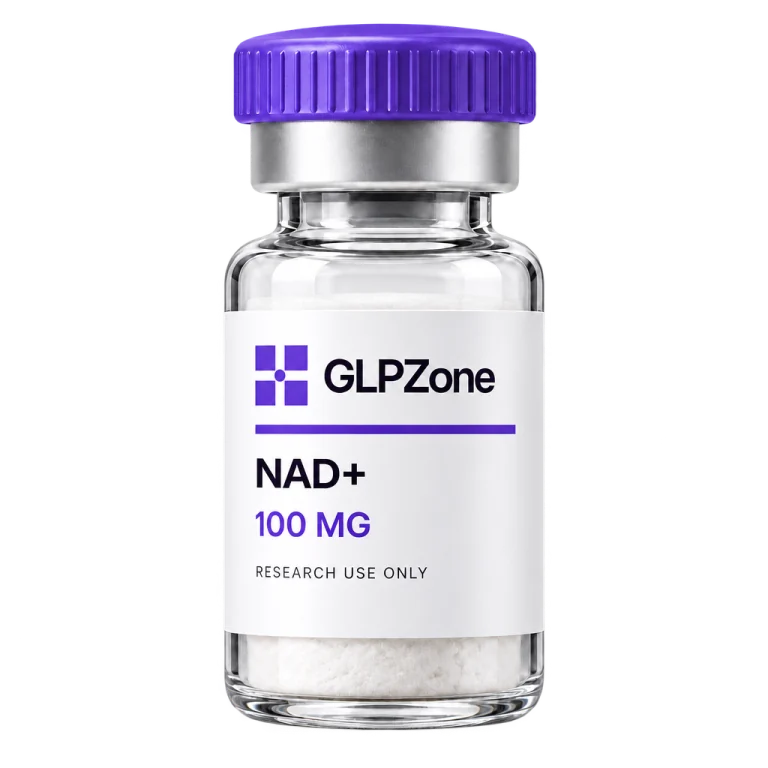
NAD+

Redox chemistry & NAD-dependent enzyme systems

$47.00USD / vialView COA

A pair saves 10%. A set of three saves 15%.

Strength 100 MG
Vial quantity
  • Complimentary priority shipping from $200
  • Dispatched within 1–2 business days
  • Compare strengths and prices before ordering

For laboratory research use only.
Not for human consumption or clinical use.

Compound details
Compound
NAD+
CAS number
53-84-9
Molecular formula
C21H27N7O14P2
Molecular weight
663.43 g/mol
Form
Lyophilized
Quality & documentation

The records shown here are illustrative. Request laboratory-issued documentation for your lot before ordering.

Lot
GLZ-26-NAD-1026
HPLC purity
99.553%
Measured content
100.4 mg
Tested
21 Sep 2026
Report
NS-2026-06027
View the 100 MG certificate
Our quality approach
Shipping & handling

Priority, tracked shipping within the United States, free on orders of $200 or more after savings. Add Priority dispatch at checkout to have your order packed first; Private Clients receive it on every order. Follow the product documentation for laboratory handling requirements.

Shipping information
Explore the research profile
NAD+100 MG · Single
$47.00

01 / The compound

Understand
the starting point.

Redox chemistry & NAD-dependent enzyme systems

NAD+ is the oxidized form of nicotinamide adenine dinucleotide, a coenzyme involved in electron-transfer reactions throughout cellular metabolism. NAD+ and its reduced counterpart, NADH, form a redox pair that helps transfer electrons between biochemical reactions.

Beyond its role in redox metabolism, NAD+ is also consumed as a co-substrate by NAD+-dependent enzyme systems including sirtuins, poly(ADP-ribose) polymerases (PARPs), and CD38. These pathways have made NAD+ metabolism an active area of laboratory research spanning cellular energetics, mitochondrial biology, stress responses, and metabolic regulation.

02 / Research profile

The pathways.
The possibilities.

NAD+ has two distinct biochemical roles: reversible electron transfer through the NAD+/NADH redox pair, and consumption as a co-substrate by NAD-dependent enzymes. These processes should not be treated as the same reaction.

01 / Research focus

Redox Metabolism

NAD+ functions as an electron-accepting coenzyme in oxidation-reduction reactions. Through its reversible conversion between NAD+ and NADH, it participates in metabolic pathways involved in the transfer and processing of cellular energy.
02 / Research focus

NAD+-Dependent Enzymes

NAD+ also acts as a consumed co-substrate for enzyme systems including sirtuins, PARPs, and CD38. Research into these systems connects NAD+ metabolism with processes such as cellular stress responses, chromatin regulation, DNA-damage signaling, calcium signaling, and metabolic homeostasis.

Reading the evidence

Research into NAD+ biology spans from cell-based models to animal physiology. In-vitro research has characterized the metabolic pathways that regulate intracellular NAD+ and the enzymes that consume it. Animal studies have investigated how experimental depletion or elevation of NAD+ influences physiological markers associated with aging. NAD+ metabolism is actively investigated across cellular, biochemical and preclinical research systems. Research in this field also frequently evaluates NAD+ precursor compounds such as nicotinamide riboside (NR) and nicotinamide mononucleotide (NMN). Findings involving these precursor compounds should not automatically be attributed to NAD+ itself.

03 / Reference data

The details,
in plain sight.

Reference specifications describe a compound. The final lot documentation identifies the material supplied.

NAD+ reference specifications
CompoundNAD+
Research areaHealthy Aging
CAS number53-84-9
Molecular formulaC21H27N7O14P2
Molecular weight663.43 g/mol
Physical formLyophilized
Vial options100 MG · 500 MG
Intended useLaboratory research only

Variant amounts are nominal catalog quantities. They are not instructions for use.

04 / Quality & documentation

A number needs
its context.

How testing works
01 / Purity

What is in the sample?

HPLC separates components under a defined method. Read the reported percentage alongside the chromatogram, wavelength, integration method, and scope of the test.

02 / Identity

Is it the expected compound?

Mass spectrometry provides molecular-mass evidence. Identity and chromatographic purity answer different questions; one cannot stand in for the other.

03 / Traceability

Does the report match the vial?

Connect the product name, variant, lot identifier, report date, and issuing laboratory. A report is useful only when its sample can be linked to the material being reviewed.

Independent analysis

Every NAD+ lot is analyzed by Nordicstar Analytical Sciences for identity, content, and purity by HPLC with LC-MS confirmation. Each certificate carries a report number and verification key that can be checked at nordicstarlabs.com/verify. Research references below describe published science, not a certificate for a vial.

Read a COA with confidence
NAD+ lot certificates
PresentationLotHPLC purityTestedCertificate
100 MG Current lotGLZ-26-NAD-102699.553%21 Sep 2026NS-2026-06027
500 MG Current lotGLZ-26-NAD-102799.750%20 Sep 2026NS-2026-06028

05 / Storage & handling

Care for
the material.

Keep lyophilized NAD+ sealed and protected from moisture, heat, and unnecessary light exposure. Follow the storage conditions provided with the product documentation for the specific material and lot.

Avoid repeated temperature changes and unnecessary exposure of the lyophilized material to ambient conditions.

Explore the handling guide

06 / Common questions

A little more
understanding.

Is NAD+ a peptide?

No. NAD+ is nicotinamide adenine dinucleotide, a dinucleotide coenzyme. It is frequently searched for and sold alongside research peptides, but it is chemically distinct from a peptide.

Is evidence for NR or NMN evidence for NAD+?

Nicotinamide riboside and nicotinamide mononucleotide are precursor compounds studied in NAD+ metabolism. They are distinct chemical entities, so a finding from a precursor experiment should not automatically be attributed to NAD+ supplied directly.

How do NAD+ and NADH differ?

NAD+ is the oxidized member of the redox pair; NADH is its reduced counterpart. Their interconversion participates in electron transfer, whereas sirtuins, PARPs and CD38 consume NAD+ through different biochemical reactions.

07 / Further reading

Go to
the source.

Selected literature for context. Read each study’s methods, experimental model, and limitations alongside its findings.

  1. 01
  2. 02
  3. 03
Our approach to research content

Curated pairings

Often studied together.

Explore the collection

Your research collection

Your bag 0

A new perspective awaits

Your bag is empty.

Explore the collection and find the compounds for your next research question.

Explore compounds

Find a research compound

Try GLP-3-RT, BPC-157, or NAD+.