For laboratory research use only. Not for human consumption.

Free U.S. shipping on $200+

Other Compounds

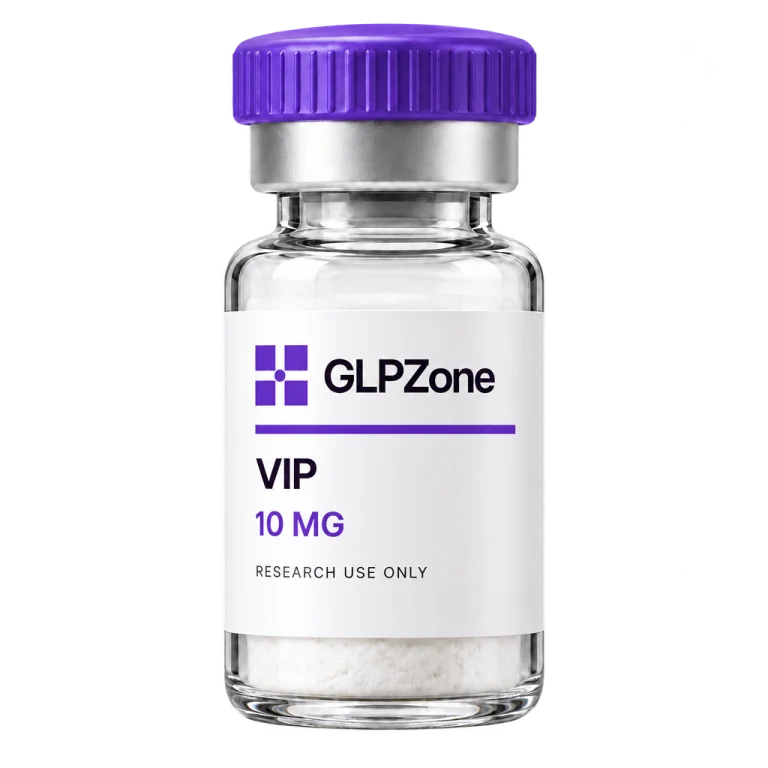
VIP

VPAC receptors, circadian coordination & cell signaling

$84.00USD / vialView COA

A pair saves 10%. A set of three saves 15%.

Strength 10 MG
Vial quantity
  • Complimentary priority shipping from $200
  • Dispatched within 1–2 business days
  • Compare strengths and prices before ordering

For laboratory research use only.
Not for human consumption or clinical use.

Compound details
Compound
VIP
CAS number
40077-57-4
Molecular formula
C147H237N43O43S
Molecular weight
3326.80 g/mol
Form
Lyophilized
Quality & documentation

The records shown here are illustrative. Request laboratory-issued documentation for your lot before ordering.

Lot
GLZ-26-VIP-1070
HPLC purity
99.594%
Measured content
10.05 mg
Tested
22 Sep 2026
Report
NS-2026-06071
View the 10 MG certificate
Our quality approach
Shipping & handling

Priority, tracked shipping within the United States, free on orders of $200 or more after savings. Add Priority dispatch at checkout to have your order packed first; Private Clients receive it on every order. Follow the product documentation for laboratory handling requirements.

Shipping information
Explore the research profile
VIP10 MG · Single
$84.00

01 / The compound

Understand
the starting point.

VPAC receptors, circadian coordination & cell signaling

Vasoactive intestinal peptide, or VIP, is a 28-amino-acid neuropeptide studied across neural, gastrointestinal, circadian and immune signaling systems. VPAC1 and VPAC2 are its principal high-affinity receptor targets.

The same signaling peptide is investigated in several tissue contexts. Receptor expression, cellular environment and downstream coupling matter when interpreting a result obtained in one experimental model.

02 / Research profile

The pathways.
The possibilities.

VPAC1 and VPAC2 belong to the class B1 family of G protein-coupled receptors. Structural and pharmacological studies examine peptide recognition and receptor-specific coupling rather than treating every VIP response as a single, uniform effect.

01 / Research focus

VPAC Receptor Signaling

VIP is studied primarily through the VPAC1 and VPAC2 receptors, two class B1 G protein-coupled receptors. Modern structural and pharmacological research has examined how VIP engages these receptors and how receptor-specific interactions influence downstream cellular signaling.
02 / Research focus

Neural, Gastrointestinal & Circadian Research

VIP is widely studied as a signaling peptide in the nervous and gastrointestinal systems. Research has examined its involvement in intestinal secretion and motility as well as neuronal and neuroendocrine signaling. Within the suprachiasmatic nucleus, the principal mammalian circadian clock, VIP/VPAC2 signaling has been shown to contribute to cellular synchronization and coordinated circadian rhythmicity.

03 / Research focus

Immune-Signaling Research

VIP and its receptors have also been investigated in experimental immune-cell systems. Cell-based research has examined VPAC1- and VPAC2-associated receptor coupling, second-messenger signaling, kinase activation, transcriptional responses and cytokine-related pathways. These responses vary according to receptor expression, cell type and experimental conditions and should not be interpreted as evidence of a therapeutic effect.

Reading the evidence

The cited findings describe the compound in the experimental systems used. Cellular, biochemical and animal results should be interpreted according to their model, methods and endpoints; they do not establish the performance of a GLPZone lot.

03 / Reference data

The details,
in plain sight.

Reference specifications describe a compound. The final lot documentation identifies the material supplied.

VIP reference specifications
CompoundVIP
Research areaOther Compounds
CAS number40077-57-4
Molecular formulaC147H237N43O43S
Molecular weight3326.80 g/mol
Physical formLyophilized
Vial options10 MG
Intended useLaboratory research only

Variant amounts are nominal catalog quantities. They are not instructions for use.

04 / Quality & documentation

A number needs
its context.

How testing works
01 / Purity

What is in the sample?

HPLC separates components under a defined method. Read the reported percentage alongside the chromatogram, wavelength, integration method, and scope of the test.

02 / Identity

Is it the expected compound?

Mass spectrometry provides molecular-mass evidence. Identity and chromatographic purity answer different questions; one cannot stand in for the other.

03 / Traceability

Does the report match the vial?

Connect the product name, variant, lot identifier, report date, and issuing laboratory. A report is useful only when its sample can be linked to the material being reviewed.

Independent analysis

Every VIP lot is analyzed by Nordicstar Analytical Sciences for identity, content, and purity by HPLC with LC-MS confirmation. Each certificate carries a report number and verification key that can be checked at nordicstarlabs.com/verify. Research references below describe published science, not a certificate for a vial.

Read a COA with confidence
VIP lot certificates
PresentationLotHPLC purityTestedCertificate
10 MG Current lotGLZ-26-VIP-107099.594%22 Sep 2026NS-2026-06071

05 / Storage & handling

Care for
the material.

Keep sealed research material protected from moisture, unnecessary light and temperature fluctuations. Use the storage conditions documented for the specific compound, formulation and lot.

Solution stability depends on solvent, concentration, container and experimental conditions. Use a validated laboratory protocol; a universal post-reconstitution shelf life is not established by the literature summaries.

Explore the handling guide

06 / Common questions

A little more
understanding.

What is VIP peptide?

VIP stands for Vasoactive Intestinal Peptide, a 28-amino-acid neuropeptide studied across receptor signaling, neural, gastrointestinal, circadian and immune research. Two of its principal high-affinity receptors are VPAC1 and VPAC2.

How is VIP linked to circadian research?

VIP/VPAC2 signaling has been studied in the suprachiasmatic nucleus, where it contributes to synchronization between cellular clocks and coordinated circadian rhythmicity in experimental models.

Does VIP have one uniform response across cell types?

No. Receptor expression and downstream coupling differ across cell types. The cited immune-cell work examines second messengers, kinases, transcriptional responses and cytokine-related pathways under specified experimental conditions.

07 / Further reading

Go to
the source.

Selected literature for context. Read each study’s methods, experimental model, and limitations alongside its findings.

  1. 01
  2. 02
  3. 03
  4. 04
  5. 05
  6. 06
Our approach to research content

Curated pairings

Often studied together.

Explore the collection

Your research collection

Your bag 0

A new perspective awaits

Your bag is empty.

Explore the collection and find the compounds for your next research question.

Explore compounds

Find a research compound

Try GLP-3-RT, BPC-157, or NAD+.