For laboratory research use only. Not for human consumption.

Free U.S. shipping on $200+

Other Compounds

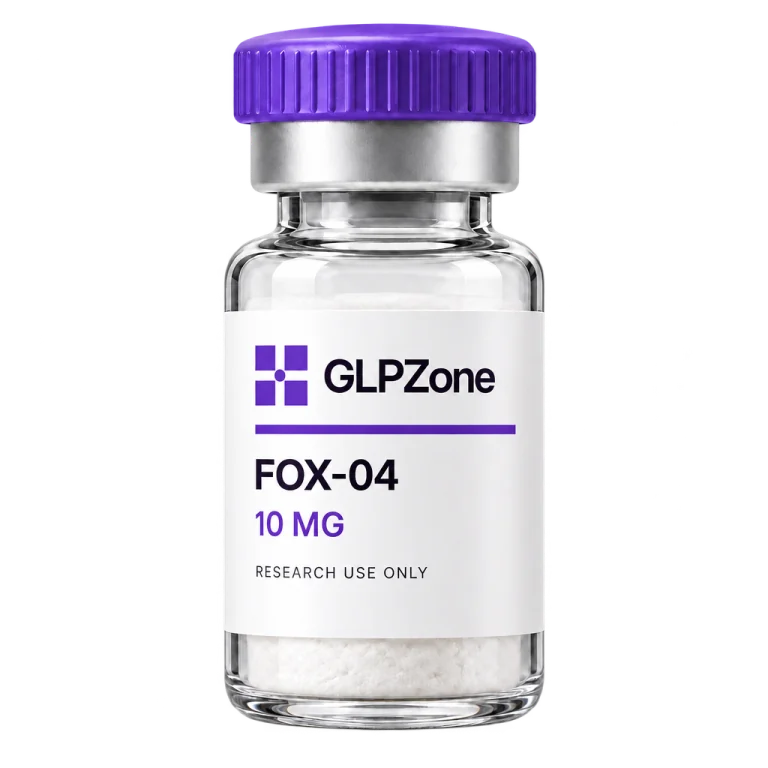
FOX-04

FOXO4-DRI · p53 interaction & senescence models

$205.00USD / vialView COA

A pair saves 10%. A set of three saves 15%.

Strength 10 MG
Vial quantity
  • Complimentary priority shipping from $200
  • Dispatched within 1–2 business days
  • Compare strengths and prices before ordering

For laboratory research use only.
Not for human consumption or clinical use.

Compound details
Compound
FOX-04
Form
Lyophilized
Quality & documentation

The records shown here are illustrative. Request laboratory-issued documentation for your lot before ordering.

Lot
GLZ-26-FOX04-1071
HPLC purity
99.701%
Measured content
10.08 mg
Tested
19 Sep 2026
Report
NS-2026-06072
View the 10 MG certificate
Our quality approach
Shipping & handling

Priority, tracked shipping within the United States, free on orders of $200 or more after savings. Add Priority dispatch at checkout to have your order packed first; Private Clients receive it on every order. Follow the product documentation for laboratory handling requirements.

Shipping information
Explore the research profile
FOX-0410 MG · Single
$205.00

01 / The compound

Understand
the starting point.

FOXO4-DRI · p53 interaction & senescence models

FOXO4-DRI, short for FOXO4 D-Retro-Inverso, is a synthetic research peptide derived from a region of the FOXO4 protein involved in its interaction with p53. It was engineered in a retro-inverso configuration using D-amino acids and incorporates a cell-penetrating sequence used in the original research design.

FOXO4-DRI is not the FOXO4 protein itself. Instead, researchers developed the peptide as an experimental tool for disrupting aspects of the FOXO4–p53 interaction, which has been investigated in models of cellular senescence. More recent structural research has shown that FOXO4-DRI interacts directly with the TAD2 region of p53 and competes with native FOXO4 binding.

02 / Research profile

The pathways.
The possibilities.

FOXO4 is a naturally occurring forkhead-family transcription factor involved in cellular signaling and gene regulation. Research into cellular senescence has identified interactions between FOXO4 and the tumor-suppressor protein p53.

FOXO4-DRI is a synthetic D-retro-inverso peptide derived from FOXO4-associated sequence design. It was developed experimentally to compete with the FOXO4–p53 interaction rather than function as the FOXO4 protein itself.

01 / Research focus

FOXO4–p53 Interaction

FOXO4-DRI was originally developed to investigate disruption of the interaction between FOXO4 and p53 in senescent-cell models. The foundational research reported changes in p53 localization and apoptosis-related signaling after FOXO4-DRI exposure in experimental systems.
02 / Research focus

Senescent-Cell Models

Subsequent studies have investigated FOXO4-DRI across several senescence models, including expanded human chondrocytes in vitro , Leydig-cell models, aged mice, fibroblast systems and endothelial-cell research. These studies remain experimental and should not be interpreted as evidence of clinical efficacy.

03 / Research focus

Molecular Mechanism Research

A 2025 Nature Communications study used NMR and other biophysical methods to characterize the FOXO4–p53 interaction in greater detail. Researchers identified p53 TAD2 as a principal FOXO4-DRI binding region and showed that FOXO4-DRI competes with FOXO4 for interaction with p53.

Reading the evidence

FOXO4-DRI remains an experimental research compound, and published findings should be interpreted within the specific models in which they were observed. Published research includes cell-based, tissue-related and animal models, but clinical efficacy in humans has not been established. In pulmonary-hypertension research, senescent-cell elimination worsened pulmonary hemodynamics in several rodent models; FOXO4-DRI was among the senolytic approaches evaluated in selected models. These findings illustrate that the biological consequences of senescent-cell removal can depend on tissue and experimental context.

03 / Reference data

The details,
in plain sight.

Reference specifications describe a compound. The final lot documentation identifies the material supplied.

FOX-04 reference specifications
CompoundFOX-04
Research areaOther Compounds
Physical formLyophilized
Vial options10 MG
Intended useLaboratory research only

Variant amounts are nominal catalog quantities. They are not instructions for use.

04 / Quality & documentation

A number needs
its context.

How testing works
01 / Purity

What is in the sample?

HPLC separates components under a defined method. Read the reported percentage alongside the chromatogram, wavelength, integration method, and scope of the test.

02 / Identity

Is it the expected compound?

Mass spectrometry provides molecular-mass evidence. Identity and chromatographic purity answer different questions; one cannot stand in for the other.

03 / Traceability

Does the report match the vial?

Connect the product name, variant, lot identifier, report date, and issuing laboratory. A report is useful only when its sample can be linked to the material being reviewed.

Independent analysis

Every FOX-04 lot is analyzed by Nordicstar Analytical Sciences for identity, content, and purity by HPLC with LC-MS confirmation. Each certificate carries a report number and verification key that can be checked at nordicstarlabs.com/verify. Research references below describe published science, not a certificate for a vial.

Read a COA with confidence
FOX-04 lot certificates
PresentationLotHPLC purityTestedCertificate
10 MG Current lotGLZ-26-FOX04-107199.701%19 Sep 2026NS-2026-06072

05 / Storage & handling

Care for
the material.

Keep sealed research material protected from moisture, unnecessary light and temperature fluctuations. Use the storage conditions documented for the specific compound, formulation and lot.

Solution stability depends on solvent, concentration, container and experimental conditions. Use a validated laboratory protocol; a universal post-reconstitution shelf life is not established by the literature summaries.

Explore the handling guide

06 / Common questions

A little more
understanding.

What is FOXO4-DRI?

FOXO4-DRI is a synthetic D-retro-inverso research peptide derived from FOXO4-associated sequence design. It has primarily been investigated in experimental models involving FOXO4–p53 signaling and cellular senescence.

What is the difference between FOXO4 and FOXO4-DRI?

FOXO4 is a naturally occurring transcription factor. FOXO4-DRI is a synthetic research peptide designed from a FOXO4-derived sequence to experimentally interfere with aspects of the FOXO4–p53 interaction. They are related research entities, but they are not the same molecule.

What does D-retro-inverso mean?

A D-retro-inverso peptide is constructed using D-amino acids in reversed sequence order, an approach designed to approximate aspects of the side-chain orientation of the corresponding parent peptide while reversing the peptide backbone direction. FOXO4-DRI was engineered using this strategy.

Has FOXO4-DRI been clinically validated?

Published FOXO4-DRI research is primarily preclinical and includes cell, tissue and animal models. Human-derived cells have been studied in vitro , but that is different from a clinical trial in human participants. Clinical efficacy in humans has not been established.

07 / Further reading

Go to
the source.

Selected literature for context. Read each study’s methods, experimental model, and limitations alongside its findings.

  1. 01
  2. 02
  3. 03
  4. 04
  5. 05
  6. 06
Our approach to research content

Curated pairings

Often studied together.

Explore the collection

Your research collection

Your bag 0

A new perspective awaits

Your bag is empty.

Explore the collection and find the compounds for your next research question.

Explore compounds

Find a research compound

Try GLP-3-RT, BPC-157, or NAD+.