For laboratory research use only. Not for human consumption.

Free U.S. shipping on $200+

Metabolic Research

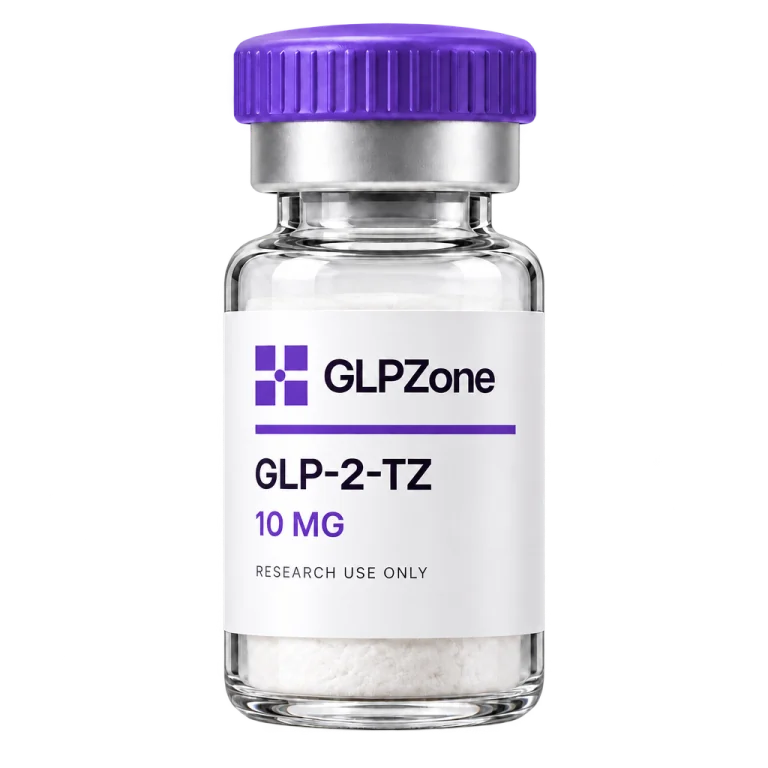
GLP-2-TZ

Tirzepatide · dual incretin receptor pharmacology

A pair saves 10%. A set of three saves 15%.

Strength 10 MG
Vial quantity
  • Complimentary priority shipping from $200
  • Dispatched within 1–2 business days
  • Compare strengths and prices before ordering

For laboratory research use only.
Not for human consumption or clinical use.

Compound details
Compound
GLP-2-TZ
CAS number
2023788-19-2
Molecular formula
C225H348N48O68
Molecular weight
4813.5 g/mol
Form
Lyophilized
Quality & documentation

The records shown here are illustrative. Request laboratory-issued documentation for your lot before ordering.

Lot
GLZ-26-GLP2TZ-1011
HPLC purity
99.657%
Measured content
10.04 mg
Tested
21 Sep 2026
Report
NS-2026-06012
View the 10 MG certificate
Our quality approach
Shipping & handling

Priority, tracked shipping within the United States, free on orders of $200 or more after savings. Add Priority dispatch at checkout to have your order packed first; Private Clients receive it on every order. Follow the product documentation for laboratory handling requirements.

Shipping information
Explore the research profile
GLP-2-TZ10 MG · Single
$69.00

01 / The compound

Understand
the starting point.

Tirzepatide · dual incretin receptor pharmacology

Tirzepatide is a synthetic 39-amino-acid peptide developed as a dual agonist of the glucose-dependent insulinotropic polypeptide receptor (GIPR) and glucagon-like peptide-1 receptor (GLP-1R).

Also identified in the scientific literature as LY3298176, tirzepatide was engineered from a GIP-based peptide sequence with structural modifications that support activity at both receptor systems.

Published research has investigated tirzepatide in receptor pharmacology, cellular signaling, structural biology and metabolic research models.

02 / Research profile

The pathways.
The possibilities.

Tirzepatide is a 39-amino-acid engineered peptide based primarily on the GIP sequence. Its molecular design includes several features that are important to its research profile:

Aib at positions 2 and 13: Two α-aminoisobutyric acid residues are incorporated into the peptide sequence.

Modified Lys20: The lysine residue at position 20 is connected through a linker to a C20 fatty diacid.

C-terminal amidation: The peptide contains an amidated C-terminus.

Dual receptor activity: The resulting molecule has experimentally demonstrated agonist activity at both GIPR and GLP-1R. Together, these features make tirzepatide a useful research compound for studying engineered multi-receptor peptide pharmacology.

Tirzepatide has been studied as a dual GIPR and GLP-1R agonist, making it useful in research investigating how two related incretin receptor systems can be activated by a single engineered peptide.

The findings from these studies describe the research behavior of tirzepatide as a molecule and should not be interpreted as instructions for use of GLPZone material.

01 / Research focus

Dual Receptor Pharmacology

Tirzepatide is classified as an engineered dual agonist of the glucose-dependent insulinotropic polypeptide receptor (GIPR) and glucagon-like peptide-1 receptor (GLP-1R). This receptor classification describes the molecular research identity of Tirzepatide and is not presented here as evidence of a clinical or therapeutic outcome.
02 / Research focus

Peptide Synthesis Research

Published process-chemistry research has examined the synthesis of Tirzepatide using peptide-assembly strategies including solid-phase synthesis and convergent approaches. These studies provide laboratory context for the production and handling of this engineered 39-residue peptide.

03 / Research focus

Process Chemistry & Impurity Research

Research on Tirzepatide synthesis has examined process-related impurity formation, including diketopiperazine formation and peptide-deletion impurities associated with specific synthetic intermediates. These findings relate to peptide process chemistry and should not be interpreted as analytical results for GLPZone material.

Reading the evidence

The references presented in this summary are used to support Tirzepatide compound identity, peptide chemistry and laboratory synthesis context. They should not be interpreted as establishing therapeutic effects, clinical outcomes or the characteristics of GLPZone material.

03 / Reference data

The details,
in plain sight.

Reference specifications describe a compound. The final lot documentation identifies the material supplied.

GLP-2-TZ reference specifications
CompoundGLP-2-TZ
Research areaMetabolic Research
CAS number2023788-19-2
Molecular formulaC225H348N48O68
Molecular weight4813.5 g/mol
Physical formLyophilized
Vial options10 MG · 20 MG · 30 MG · 40 MG · 50 MG · 60 MG · 70 MG · 80 MG · 90 MG · 100 MG · 120 MG
Intended useLaboratory research only

Variant amounts are nominal catalog quantities. They are not instructions for use.

04 / Quality & documentation

A number needs
its context.

How testing works
01 / Purity

What is in the sample?

HPLC separates components under a defined method. Read the reported percentage alongside the chromatogram, wavelength, integration method, and scope of the test.

02 / Identity

Is it the expected compound?

Mass spectrometry provides molecular-mass evidence. Identity and chromatographic purity answer different questions; one cannot stand in for the other.

03 / Traceability

Does the report match the vial?

Connect the product name, variant, lot identifier, report date, and issuing laboratory. A report is useful only when its sample can be linked to the material being reviewed.

Independent analysis

Every GLP-2-TZ lot is analyzed by Nordicstar Analytical Sciences for identity, content, and purity by HPLC with LC-MS confirmation. Each certificate carries a report number and verification key that can be checked at nordicstarlabs.com/verify. Research references below describe published science, not a certificate for a vial.

Read a COA with confidence
GLP-2-TZ lot certificates
PresentationLotHPLC purityTestedCertificate
50 MG Current lotGLZ-26-GLP2TZ-101599.588%25 Sep 2026NS-2026-06016
40 MG Current lotGLZ-26-GLP2TZ-101499.771%24 Sep 2026NS-2026-06015
80 MG Current lotGLZ-26-GLP2TZ-101899.757%24 Sep 2026NS-2026-06019
90 MG Current lotGLZ-26-GLP2TZ-101999.667%24 Sep 2026NS-2026-06020
30 MG Current lotGLZ-26-GLP2TZ-101399.733%23 Sep 2026NS-2026-06014
70 MG Current lotGLZ-26-GLP2TZ-101799.719%23 Sep 2026NS-2026-06018
100 MG Current lotGLZ-26-GLP2TZ-102099.629%23 Sep 2026NS-2026-06021
20 MG Current lotGLZ-26-GLP2TZ-101299.695%22 Sep 2026NS-2026-06013
10 MG Current lotGLZ-26-GLP2TZ-101199.657%21 Sep 2026NS-2026-06012
60 MG Current lotGLZ-26-GLP2TZ-101699.626%14 Sep 2026NS-2026-06017
120 MG Current lotGLZ-26-GLP2TZ-102199.743%14 Sep 2026NS-2026-06022

05 / Storage & handling

Care for
the material.

This guidance applies only to the sealed research material. There is no universal post-reconstitution stability period because solution stability varies by concentration, solvent, formulation, container, and storage conditions.

Explore the handling guide

06 / Common questions

A little more
understanding.

Is Tirzepatide a peptide?

Yes. Tirzepatide is a synthetic 39-amino-acid peptide engineered to activate both the GIP receptor and GLP-1 receptor.

What is LY3298176?

LY3298176 is the development code used for tirzepatide in its discovery and early research literature. It refers to the same peptide entity now known as tirzepatide.

How many amino acids are in Tirzepatide?

Tirzepatide contains 39 amino-acid residues, including two non-standard α-aminoisobutyric acid residues at positions 2 and 13.

Which receptors does Tirzepatide interact with?

Tirzepatide is a dual agonist of the glucose-dependent insulinotropic polypeptide receptor (GIPR) and the glucagon-like peptide-1 receptor (GLP-1R). Published cellular and structural studies have characterized its interaction with both receptor systems.

07 / Further reading

Go to
the source.

Selected literature for context. Read each study’s methods, experimental model, and limitations alongside its findings.

  1. 01
  2. 02
Our approach to research content

Curated pairings

Often studied together.

Explore the collection

Your research collection

Your bag 0

A new perspective awaits

Your bag is empty.

Explore the collection and find the compounds for your next research question.

Explore compounds

Find a research compound

Try GLP-3-RT, BPC-157, or NAD+.