GIPR
Retatrutide demonstrates agonist activity at the glucose-dependent insulinotropic polypeptide receptor. The original discovery research reported greater GIPR activity relative to its GCGR and GLP-1R activity.
For laboratory research use only. Not for human consumption.
Free U.S. shipping on $200+GLPZone / The research collection
 Illustrative certificateNS-2026-06001
Nordicstar Analytical Sciences
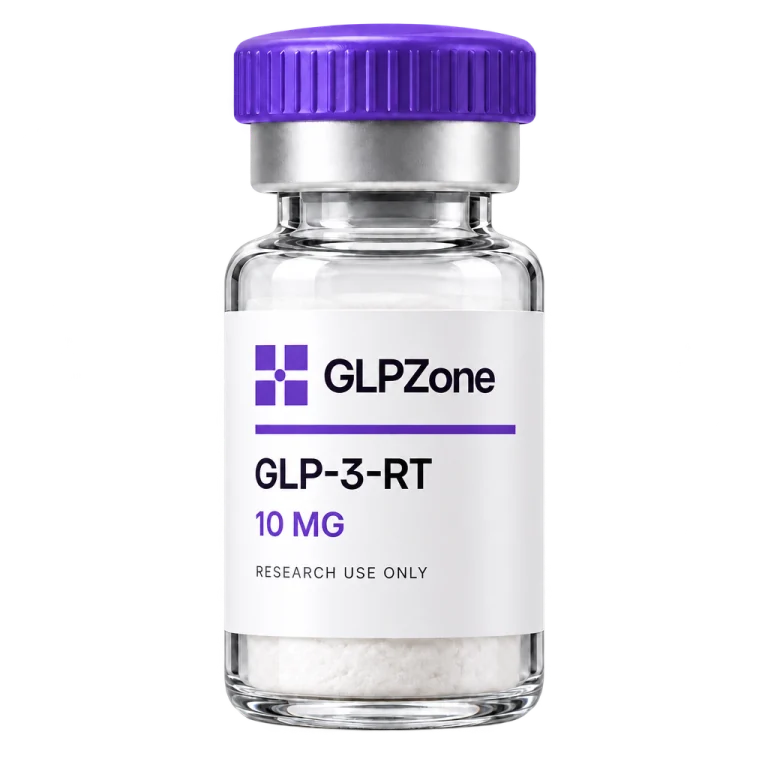
GLP-3-RT 10 MG
Illustrative certificateNS-2026-06002Nordicstar Analytical Sciences
GLP-3-RT 15 MG
Illustrative certificateNS-2026-06003Nordicstar Analytical Sciences
GLP-3-RT 20 MG
Illustrative certificateNS-2026-06004Nordicstar Analytical Sciences
GLP-3-RT 30 MG
Illustrative certificateNS-2026-06005Nordicstar Analytical Sciences
GLP-3-RT 40 MG
Illustrative certificateNS-2026-06006Nordicstar Analytical Sciences
GLP-3-RT 50 MG
Illustrative certificateNS-2026-06007Nordicstar Analytical Sciences
GLP-3-RT 60 MG
Metabolic Research
Retatrutide · GIPR, GLP-1R & glucagon receptor research
A pair saves 10%. A set of three saves 15%.
For laboratory research use only.
Not for human consumption or clinical use.
The records shown here are illustrative. Request laboratory-issued documentation for your lot before ordering.
Priority, tracked shipping within the United States, free on orders of $200 or more after savings. Add Priority dispatch at checkout to have your order packed first; Private Clients receive it on every order. Follow the product documentation for laboratory handling requirements.
Shipping information01 / The compound
Retatrutide · GIPR, GLP-1R & glucagon receptor research
Retatrutide, also known by the development identifier LY3437943, is a synthetic peptide designed to interact with three receptor systems: the glucose-dependent insulinotropic polypeptide receptor, glucagon-like peptide-1 receptor and glucagon receptor.
Laboratory research has examined its multi-receptor pharmacology, receptor activation profile and signaling behavior. Its triple-agonist design makes it useful for studying how coordinated activity across GIPR, GLP-1R and GCGR differs from single- or dual-receptor agonism.
02 / Research profile
Early Retatrutide research characterized the compound's molecular design and activity across GIP, GLP-1 and glucagon receptor systems.
The compound is particularly relevant to laboratory research examining multi-receptor agonism, receptor selectivity and the signaling consequences of combining three incretin- and glucagon-related pathways within a single peptide molecule.
Structural comparison across the three receptor complexes helps distinguish a shared agonist design from identical behavior at each target. Receptor selectivity and signaling remain separate experimental questions from a vial’s analytical purity.
Retatrutide demonstrates agonist activity at the glucose-dependent insulinotropic polypeptide receptor. The original discovery research reported greater GIPR activity relative to its GCGR and GLP-1R activity.
GLP-1 receptor agonism forms the second component of Retatrutide's multi-receptor research profile.
Glucagon receptor agonism completes the compound's triple-receptor profile and distinguishes Retatrutide from peptides designed around only one or two of these receptor systems.
Reading the evidence
The selected literature concerns receptor structure, preclinical metabolic models and isolated tissue preparations. It establishes research context for the molecule, not purity, identity or performance of a GLPZone batch.
03 / Reference data
Reference specifications describe a compound. The final lot documentation identifies the material supplied.
| Compound | GLP-3-RT |
|---|---|
| Research area | Metabolic Research |
| CAS number | 2381089-83-2 |
| Molecular formula | C221H343N53O68 |
| Molecular weight | 4731.4 g/mol |
| Physical form | Lyophilized |
| Vial options | 10 MG · 15 MG · 20 MG · 30 MG · 40 MG · 50 MG · 60 MG |
| Intended use | Laboratory research only |
Variant amounts are nominal catalog quantities. They are not instructions for use.
HPLC separates components under a defined method. Read the reported percentage alongside the chromatogram, wavelength, integration method, and scope of the test.
Mass spectrometry provides molecular-mass evidence. Identity and chromatographic purity answer different questions; one cannot stand in for the other.
Connect the product name, variant, lot identifier, report date, and issuing laboratory. A report is useful only when its sample can be linked to the material being reviewed.
Every GLP-3-RT lot is analyzed by Nordicstar Analytical Sciences for identity, content, and purity by HPLC with LC-MS confirmation. Each certificate carries a report number and verification key that can be checked at nordicstarlabs.com/verify. Research references below describe published science, not a certificate for a vial.
Read a COA with confidence| Presentation | Lot | HPLC purity | Tested | Certificate |
|---|---|---|---|---|
| 10 MG Current lot | GLZ-26-GLP3RT-1000 | 99.641% | 25 Sep 2026 | NS-2026-06001 |
| 15 MG Current lot | GLZ-26-GLP3RT-1001 | 99.603% | 24 Sep 2026 | NS-2026-06002 |
| 20 MG Current lot | GLZ-26-GLP3RT-1002 | 99.565% | 23 Sep 2026 | NS-2026-06003 |
| 30 MG Current lot | GLZ-26-GLP3RT-1003 | 99.610% | 18 Sep 2026 | NS-2026-06004 |
| 40 MG Current lot | GLZ-26-GLP3RT-1004 | 99.572% | 17 Sep 2026 | NS-2026-06005 |
| 50 MG Current lot | GLZ-26-GLP3RT-1005 | 99.755% | 16 Sep 2026 | NS-2026-06006 |
| 60 MG Current lot | GLZ-26-GLP3RT-1006 | 99.717% | 15 Sep 2026 | NS-2026-06007 |
| 40 MG | GLZ-26-GLP3RT-796 | 99.579% | 21 Aug 2026 | NS-2026-06081 |
| 50 MG | GLZ-26-GLP3RT-795 | 99.724% | 19 Aug 2026 | NS-2026-06083 |
| 10 MG | GLZ-26-GLP3RT-800 | 99.739% | 16 Aug 2026 | NS-2026-06073 |
| 15 MG | GLZ-26-GLP3RT-799 | 99.663% | 14 Aug 2026 | NS-2026-06075 |
| 60 MG | GLZ-26-GLP3RT-794 | 99.731% | 13 Aug 2026 | NS-2026-06085 |
| 20 MG | GLZ-26-GLP3RT-798 | 99.587% | 12 Aug 2026 | NS-2026-06077 |
| 30 MG | GLZ-26-GLP3RT-797 | 99.732% | 10 Aug 2026 | NS-2026-06079 |
| 20 MG | GLZ-26-GLP3RT-698 | 99.694% | 17 Jul 2026 | NS-2026-06078 |
| 40 MG | GLZ-26-GLP3RT-696 | 99.762% | 16 Jul 2026 | NS-2026-06082 |
| 50 MG | GLZ-26-GLP3RT-695 | 99.769% | 10 Jul 2026 | NS-2026-06084 |
| 10 MG | GLZ-26-GLP3RT-700 | 99.625% | 09 Jul 2026 | NS-2026-06074 |
| 60 MG | GLZ-26-GLP3RT-694 | 99.693% | 08 Jul 2026 | NS-2026-06086 |
| 15 MG | GLZ-26-GLP3RT-699 | 99.770% | 07 Jul 2026 | NS-2026-06076 |
| 30 MG | GLZ-26-GLP3RT-697 | 99.617% | 06 Jul 2026 | NS-2026-06080 |
05 / Storage & handling
Keep lyophilized Retatrutide protected from heat, light, and moisture.
For long-term storage of unopened research material, follow the handling information supplied with the product.
Explore the handling guide06 / Common questions
Retatrutide, also known as LY3437943, is a synthetic peptide studied for agonist activity at the GIP, GLP-1, and glucagon receptors.
The retatrutide research profile includes GIPR, GLP-1R and GCGR. Tirzepatide is studied as a dual GIPR/GLP-1R agonist, while semaglutide is a selective GLP-1R agonist. These classifications describe receptor pharmacology rather than interchangeable material identities.
The reference set includes receptor structural research, animal metabolic models and isolated mouse atrial preparations. Each addresses a different experimental question; findings from one model should not be generalized to the other.
07 / Further reading
Selected literature for context. Read each study’s methods, experimental model, and limitations alongside its findings.
Curated pairings